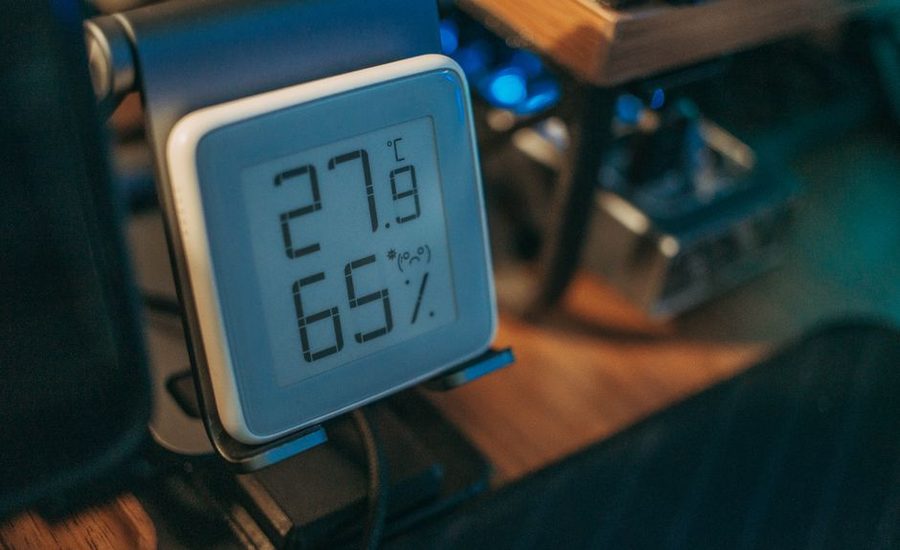
The old thermometer had been screwed to the same bracket for eleven years, and for the last two of those it had started doing something hard to name precisely: not failing, just answering a little slower than it used to, and settling half a degree warm on the still afternoons when nothing should have separated it from a fresh instrument. The temptation, once a replacement was bought, was to swap it in on a Saturday morning and carry on the log without a pause. That would have been the easy version of this entry. Instead the old unit stayed mounted for four more weeks, side by side with the new one, both read at the same two times a day, so that whatever gap existed between them would show up in numbers instead of hunch before either one was allowed to speak for the record alone.
Why a clean swap breaks a series
A daily temperature log is only useful if a change in the numbers means a change in the weather. The moment an instrument is swapped without overlap, that assumption gets quietly broken. If the new thermometer reads consistently a few tenths different from the old one — through a different mount, a different time constant, a different age of paint on the radiation shield — that offset lands in the log on one specific date and looks exactly like a shift in the local climate. Nobody reading the monthly figures a year later, the way a monthly average tends to flatten the details that produced it, would have any way to tell a real July from an instrument change dressed up as one.
Setting up the overlap
The protocol was deliberately plain. Both thermometers went into the same screen, at the same height, a few inches apart, with nothing between them and the airflow that would have favored one over the other. Readings were taken at the two fixed times the log already used — late morning and early evening — and each was written down independently before comparing them, so that seeing the old number first wouldn't quietly nudge the new one into agreement. The overlap ran for a full four weeks rather than a few days, on the reasoning that a short window might land entirely in one kind of weather and miss how the two instruments behaved under a front, a still high-pressure spell, and an overcast stretch in between.
A parallel run is only as useful as what gets written alongside it. Four things belong in the notebook before the changeover: the exact mount position and height of each instrument, the model or type of each sensor, the start and end date of the overlap, and the raw paired readings themselves — not just the averaged difference. The difference can always be recomputed later; the raw pairs can't be recovered once the old unit is gone.
What four weeks of paired readings showed
The two instruments did not disagree by a fixed number, which was the first useful thing the overlap revealed. On overcast, breezy days they were close — within a tenth of a degree either way. On clear, calm afternoons the gap opened up, with the older thermometer reading warm, consistent with the slow response and a shield that had faded and absorbed more radiant heat over a decade outdoors. A single spot-check would have caught one end of that range and missed the other entirely.
| Date | Conditions | Old (°F) | New (°F) | Difference |
|---|---|---|---|---|
| Wk 1, Tue | Overcast, breezy | 68.4 | 68.3 | +0.1 |
| Wk 1, Fri | Clear, calm, noon | 81.9 | 81.2 | +0.7 |
| Wk 2, Wed | Passing front | 72.6 | 72.8 | −0.2 |
| Wk 3, Sat | Clear, calm, noon | 84.1 | 83.3 | +0.8 |
| Wk 4, Mon | Light rain | 70.0 | 70.1 | −0.1 |
A sample of the paired-reading log; the full four weeks of noon and evening pairs are kept in the station notebook, not reproduced here.
The gap wasn't a number to correct for — it was a pattern to write down, and the pattern turned out to matter more than the average of it.
Deciding what to do with the offset
Because the difference between the two instruments changed with the weather instead of sitting at a fixed value, applying a single blanket correction to the old data would have traded one kind of error for another. The choice made here was to leave the historical record from the old thermometer alone, mark the exact date of the changeover clearly in the log, and treat the two segments of the series as related but not identical — the same approach used for a screen move earlier in the log, where the more honest fix was a documented break rather than a forced correction. A few things came out of the overlap worth keeping in mind for any instrument change:
- Offsets between instruments are rarely constant; they tend to open up under clear, calm conditions and shrink under wind or cloud.
- A radiation shield's age and finish can matter as much as the sensor inside it.
- Two fixed reading times a day, kept over several weeks, catch more of the real range than a handful of scattered checks.
- The changeover date itself is data — it belongs in the log with the same care as a daily high or low.
If the old instrument doesn't last the overlap
Not every changeover goes as planned. An instrument retired for cause — cracked casing, a stuck reading, obvious damage — may not survive four weeks of comparison at all, and in that case a shorter overlap, even a single week, is still worth more than none. The record simply carries a note that the comparison window was short and the offset estimate is less certain, rather than pretending a longer overlap happened. A partial comparison, clearly labeled as partial, keeps the series honest in a way that silence never does.
This entry describes one station's approach to comparing two instruments during a changeover. It is a record of method, not a recommendation for any particular thermometer, shield, or calibration routine, and it isn't a substitute for guidance from an instrument's own documentation.