What Three Summers of Noon Readings Actually Show
A single fixed hour, tracked for three years, turns out to hide as much as it reveals.
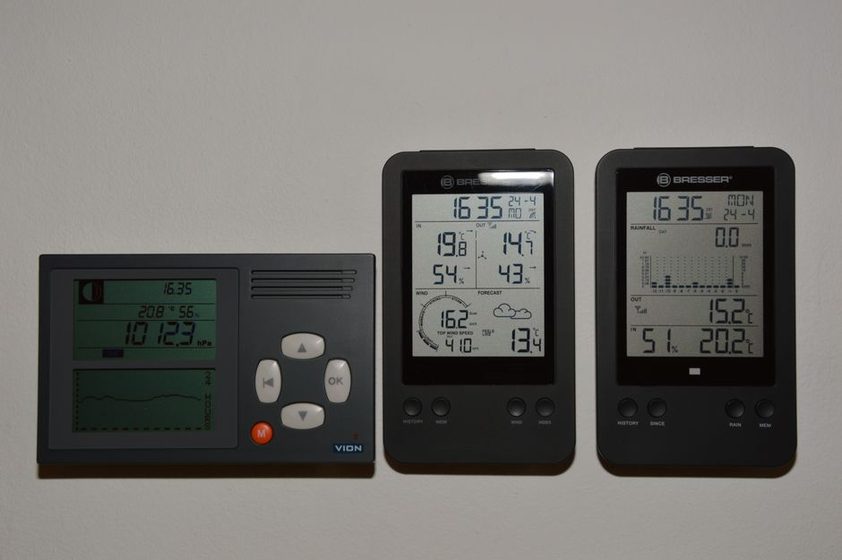
Three summers ago I started writing down the temperature and pressure at noon, every day, in a notebook kept on the windowsill next to the station. Noon was chosen for a boring reason: it was the one hour I could reliably be home and looking at the instruments rather than at a screen recording them for me. There was no plan beyond consistency. A year in, the column of numbers looked tidy enough to mean something. Two years in, it looked like a climate record in miniature. It took most of the third year to notice how much of the actual weather that single daily line had been quietly leaving out.
Why Noon, and Why It Seemed Enough
Noon has an obvious appeal for a hand-kept log. The sun is close to its highest point, the household routine is settled, and the reading falls at roughly the same solar time across the year, which makes month-to-month comparison feel fair. Meteorologists have used fixed observation hours for exactly this reason for a long time — a repeatable sample beats an irregular one, even if the sample itself is narrow. What I did not appreciate at the start is how much can happen in the twenty-three hours the log never looks at.
What Three Years of the Same Hour Actually Contain
A noon-only series is, technically, a time series — but it is a time series of one moment repeated, not a record of the day around it. Over three summers that distinction stopped being academic. Some noon readings landed during a calm, settled stretch and matched the day's average closely. Others landed in the middle of a passing front, a morning fog burning off late, or a pressure trough that had already bottomed out an hour earlier and was on its way back up by the time I wrote the number down. The log could not tell the difference between these cases after the fact; a steady-looking number and a number caught mid-swing occupy the same line in the notebook.
This is part of the same problem covered in the monthly average hides the day it happened — averaging in time and sampling at a single hour are different tricks, but they fail in a similar way. Both replace a shape with a point.
Term worth knowing
The diurnal range is the difference between a day's highest and lowest reading of a given variable. Pressure at a fixed location typically completes something close to two small oscillations a day (a semidiurnal pattern), on top of whatever a passing weather system adds. A noon sample catches one point on that combined curve, not the curve itself.
The Days Noon Got It Wrong
Going back through three years of logbook entries and comparing them against the station's own continuous hourly export — kept quietly in parallel, mostly as a backup — turned up a handful of days where the noon figure was almost a decoy. A few of the clearer examples, chosen because the gap between the single sample and the day's actual range was largest:
| Date | Noon reading | Day's full range | What noon alone suggested | Spread the log missed |
|---|---|---|---|---|
| 2024-07-03 | 1015.6 mb | 1011.2–1017.9 mb | A quiet, settled day | 6.7 mb |
| 2024-08-19 | 74.1°F | 61.4–86.2°F | A mild, unremarkable afternoon | 24.8°F |
| 2025-06-30 | 1013.0 mb | 1006.4–1013.8 mb | Pressure near normal | 7.4 mb |
| 2025-07-22 | 79.0°F | 68.9–91.3°F | A comfortable summer noon | 22.4°F |
| 2026-06-11 | 1016.2 mb | 1014.9–1019.0 mb | Stable high pressure | 4.1 mb |
Hourly comparison data from the station's own continuous export, same three-summer period. Single-station log, not a regional reference.
The notebook says 1013 millibars, steady. It does not say that pressure had dropped four millibars by mid-morning and climbed back by noon, which was the entire story of that afternoon's storm.
What a Second Daily Reading Would Have Caught
None of this means the noon-only log was a waste of three summers — it wasn't. It is genuinely useful for questions like "was this July warmer at midday than last July," where the fixed hour is exactly the right tool. The trouble only shows up when the same single number gets asked a question it was never built to answer, like "was this a calm week" or "did the front actually pass through." For that kind of question, even one more fixed reading a day — early morning, say — would have cut the blind spot roughly in half, because it would have caught the overnight low that noon systematically misses in summer.
Anyone weighing whether to add a second reading time might also want to read reading the trend arrow correctly, or not at all, since a two-point-a-day log changes what that arrow can honestly claim to show.
- A fixed single reading is good for comparing the same hour across years, not for describing a day.
- Adding a second fixed hour is cheap and roughly doubles what the log can say about daily swings.
- A continuous logger, even a basic one, resolves the question entirely — but it changes what kind of project the log is.
- Keeping both the old noon-only column and a newer fuller record side by side made the gap between them obvious in a way that neither alone would have.
Reading a Series Like This Without Overtrusting It
The honest conclusion after three summers is narrower than it felt after one. A noon reading is a real data point, not a guess, and stacked over years it says something true about how that particular hour has behaved. It just cannot be asked to stand in for the day, the week, or the season without checking, at least occasionally, what was happening on either side of it. The check does not require new equipment — comparing a handful of noon entries against whatever continuous record exists, even a neighbor's station or an old logger pulled out of a drawer, is usually enough to see whether the fixed hour has been representative lately or not.
This entry describes one home station's logbook over three specific summers. It is a record of what one instrument, in one location, showed — not a general claim about how any fixed-hour reading behaves everywhere. Anyone keeping a similar log is better served by comparing it against their own fuller record than by assuming these particular numbers travel.